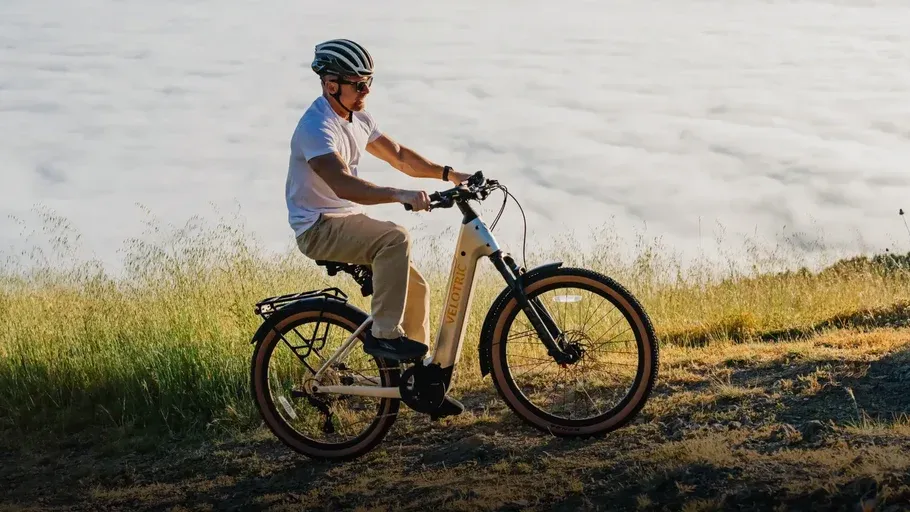
But what do these sensors do? How are they different from each other? Let’s break down how these components work and how they ultimately change your riding experience. To break down this landscape, we’ve compiled bikes across the price spectrum, each representing a different part of the market in terms of additional features.
The Cadence-Only Set-Up

A cadence sensor acts like a basic on/off switch based on pedal movement. It uses magnets to detect if and how fast you are spinning the pedals. When you turn the pedals, there is usually a slight delay before the motor kicks in with a surge of power, delivering assistance based on your chosen Assist Level regardless of how hard you press. They are inexpensive and great for riders who want maximum propulsion with minimal effort, but they can feel jerky and unnatural.
HeyBike Ranger 2.0

The Heybike Ranger 2.0 is an updated fat-tire foldable e-bike and an alternative to the brand's commuter-focused Mras series. It costs $749 and features a nominal 750W rear-hub motor and a 600Wh battery. The brand estimates the bike can run about 65 miles, while dual hydraulic disc brakes handle stopping duties. The bike also features a 7-speed Shimano gear system and integrated front and rear lights. The bike uses a 32-pulse cadence sensor, an upgrade over the previous generation’s 12-pulse sensor, which helps keep it affordable.
Lectric XP Lite2

At $799, the Lectric XPLite2 is the most affordable entry on our list. It features a 300W rear-hub motor that can generate 28 Nm of torque and comes with a 375Wh battery on the standard build, which can take you 45 miles. You can upgrade the battery to a 672 Wh version or upgrade the drivetrain to a Gates carbon belt drive from the single-geared chain drive.
This bike's budget-friendliness really shows. It features a single-speed chain drive (unless you upgrade) and has only the basic cadence sensors. Although rebranded as a “PWR” system, it is still basic and doesn’t sense your pedal power.
The GoTrax Accord

The GoTrax Accord costs $548 and features a 350W motor paired with a 360Wh battery that can keep you riding for an estimated 40 miles. It tops out at 20 mph and has only a basic speed sensor and a cadence sensor. It features only front-wheel suspension and is a hardtail model. The cadence sensor works in conjunction with the Shimano 7-speed gear system to deliver power in one of 5 PAS modes.
Torque-Sensor Only Systems

A torque sensor measures the physical force you press down on the pedals using strain gauges. Power delivery is instant and proportional. So, if you press lightly, you get a little assist; if you stomp hard, the motor unleashes maximum power.
Velotric T1 ST+

Velotric's lightweight T1 ST Plus costs $1399 and weighs just 39 lbs. It features a modest 350W motor that can generate 40 Nm of torque. Its dual hydraulic brakes provide safe stopping. The bike has a 352 Wh battery that can keep you riding about 70 miles, depending on which of the 3 PAS modes you use. The Shimano 8-speed gear system pairs with the torque system to deliver power across all terrains and only as needed.
Aventon Soltera 3 ADV

The Aventon Soltera 3 ADV costs $1499 and features a 250W motor and a 366 Wh battery with an estimated range of 70 miles, depending on the riding mode you choose. It also features a single-speed carbon belt drive, which makes maintenance easy and increases longevity. The bike’s dual hydraulic disc brakes stop you quickly and efficiently. However, the best part of this bike is its seamless integration into your tech ecosystem, using both the Aventon app & connecting to your “Find My” network.
Ride1Up TrailRush

Priced at $2095, the Ride1Up TrailRush is the ultimate eMTB for trail lovers. It features a top-of-the-line Brose 250W motor that can generate 90Nm of torque. The motor is paired with a 504Wh battery and a dual-suspension set-up that includes a 120mm front fork, a 150mm seat drop post, and an 11-speed Shimano gear system. Crucially, this bike only features the Intui-drive torque sensor, which delivers power to your feet only as and when you pedal.
The Hybrid Set-Up

Why pick one, when you can have both? These e-bikes give you the best of everything. The measured power delivery of torque sensors, combined with the regular surge each time you pedal from a cadence sensor. These are usually flagship and luxury-forward e-bikes that cost upwards of $2000
Aventon Aventure 3

The $1999 Aventon Aventure 3 hopes to give you the best of both worlds. It blends the luxurious commuter with the rugged eMTB. The bike features a 750W hub-drive motor and a 733Wh battery that can take you an estimated 65 miles. The class-2 e-bike also has integrated front & rear lights and a front suspension fork with 80mm travel. The bike uses both torque and cadence sensors to deliver power smoothly and efficiently.
Velotric Discover M

The $2499 Velotric Discover M is a mid-drive flagship e-bike from one of America’s most notable manufacturers and features a 500W motor. It pairs an 801 Wh battery with an IPX7 waterproofing rating. Depending on which of the 3 PAS modes or the throttle mode you use, the large battery lets you go anywhere from 70 to 95 miles per full charge. The 9-speed Shimano gear system makes riding easy, while the dual-Tektros disc brakes make stopping easy. Like the Aventon, this bike features both Cadence and Torque sensors, ensuring smooth power delivery.
Specialized Turbo Como 4.0 IGH

Priced at $2899, the Specialized Turbo Como 4.0 IGH is the very apex of our list. It features the Specialized 2.0 mid-drive motor, which generates 70 Nm of torque. It pairs a 710Wh internal battery with an Enviolo internal gear hub (IGH) and dual integrated mid-drive sensors. Additionally, it features Garmin radar integration that warns of approaching cars, an ultra-low step-through frame, and a fully enclosed belt or chain drive. The Enviolo Internal Gear Hub lets you change gears while stopped at a red light, and Specialized’s proprietary dual-sensor telemetry constantly samples leg movement to deliver a perfectly smooth ride.
Where Does This Leave You?

When do you stop paying for tangible performance and utility, and start paying for luxury branding and gimmicky extras? And do you need both sensors? Or is one good enough? The data shows the pure-utility sweet spot sits between $1,300 and $2,000. In this tier, every dollar spent directly upgrades your core mechanical safety and riding dynamics. And to answer whether a torque sensor is worth it - in short, yes! It is definitely worth it if you plan to ride for extended periods because it reduces effort. dramatically improves hill-climbing balance and boosts longevity.